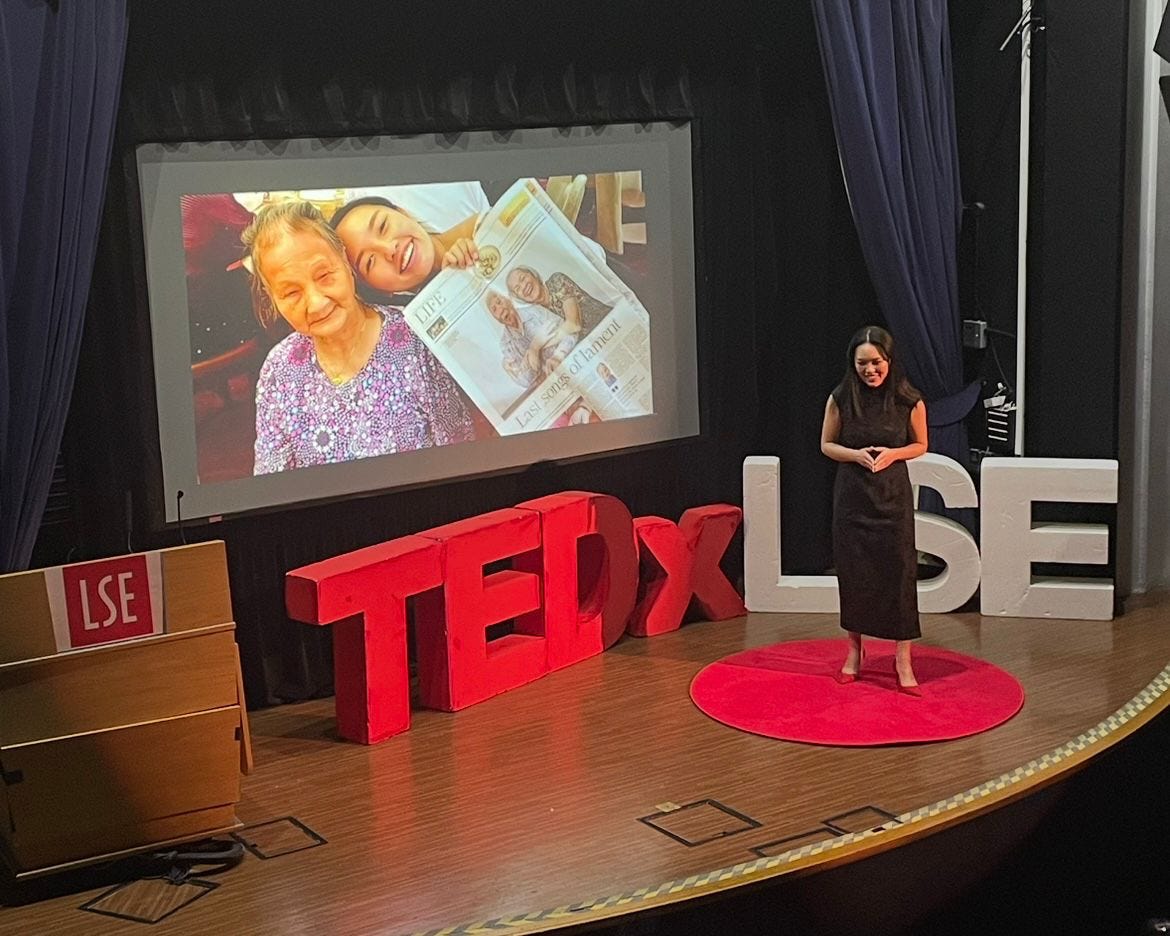
“Why don’t you have a penis?”
“You can try to make yourself a penis.”
Misogyny is most dangerous when it is internalized by women themselves, turning into a cycle of pain we keep alive by repeating the stories we were taught.
Every one of us is born into a system. First, there is the immediate family. Then the extended family, neighbors, schools, and workplaces. These systems determine our access to healthcare, insider information, and informal protection.
History is written and rewritten by those who hold power. A story is already being told about us before we are born. Before we are given the tools to understand or challenge these systems, we are taught to accept our place within them.
A daughter married away is like spilled water. (嫁出去的女,潑出去的水。)
In agrarian societies shaped by chronic scarcity, power condensed into two enduring forms: financial power and manpower. Land, labor, and lineage determined survival. Within landholding families, men remained in the lineage after marriage, worked the land, and carried the family name forward. Women, by contrast, were expected to marry out. Any labor, fertility, or caregiving they provided would ultimately benefit another household rather than their natal family.
In practical terms, women were not treated as long-term investments expected to generate returns for their own lineages. From this material reality emerged a story, and from the story, a set of rules. Marriage was framed as women’s greatest protection and their primary path to security.
The story can appear cruel when viewed through a modern lens, but its function was not moral; it was structural. Few instruments are more effective at maintaining social order than a belief system that presents itself as natural, inevitable, and beyond question.
“Remember, just do what you’re told to do and don’t ask why.”
A family elder repeated this to me again and again, not harshly, but with a steady insistence that love and respect should be expressed through compliance rather than questioning, and that restraint, in this context, was the proper form of devotion. It was for my grandmother’s funeral, and sometimes, to love means making yourself smaller so the system can remain intact.
Within inter-lineage imperial governance, single-surname lineage families functioned as the basic units of stability. Bloodline ties reinforced order and continuity across generations, enabling large-scale coordination in the absence of surplus.
In contrast to Western political thought, which prioritizes individual rights, Eastern political traditions historically placed the system above the individual. This logic was impersonal by design. Stability was preserved not through individual protection, but through systemic coherence.
Marriage, within this framework, was not primarily romantic or personal. It functioned as a mechanism of redistribution. Financial power and manpower were reallocated across lineages to preserve balance, reinforce alliances, and sustain the system itself.
“Your daughter is too Westernized.”
My mother was told this implicitly, as if there were no existing container within the system prepared to hold me as I am. But it did not mean that I fully belonged in the West either. Was a woman who had not married expected to belong anywhere at all, or simply water waiting to be spilled?
But I am truly, proudly, a Tang daughter, raised by a grandmother who sacrificed her entire life in service of the system, from an arranged marriage, to decades of labor, to naming an inheritor “without a penis,” in direct violation of what the system allowed. My very existence violated the rules. The system was never designed to contain me.
And yet, fighting the system also meant fighting who I am, because it is the same system that bore witness to my becoming, that moved through puberty with me, and that saw both my rises and my falls.
When my grandmother’s life was coming to an end, and I finally chose to stay, for once, I looked back from beside the coffin and saw that it was the system that held me when I needed it. The gendered violence I endured was only a reflection of what each of them had been forced to endure.
Kneeling in front of the coffin that held my grandmother’s body, I could not name what I felt. I was angry, sad, guilty, tired, and relieved all at once. All my feelings curled up inside me, seeking somewhere to rest, or to burst open.
I know that until her last breath, she saw me. After all, she too had once been a Weitou daughter, raised by her grandmother. From the very beginning, I was chosen to be protected and loved. She chose me, and she gave me everything she had, even when I did not yet know how to choose her the way she chose me.
How cruel it is to bet an entire life on a single person. I was never supposed to be an investment, yet I became one.
“I want to be a man in my next life.”
My grandmother used to say.