I used to be that annoying friend who stood in front of store windows and couldn’t decide whether to buy something. I was terrified of making decisions. It got to the point where my friend would start counting “1, 2, 3” whenever I hesitated. What I didn’t realize then is this:
There is no perfect decision.
Internet gurus love mental models for guiding decisions. Clean rules for messy lives. Some entrepreneurs favor a famous one:
If it’s not a “hell yes,” it’s a no.
I like speaking with venture capitalists. They sit on unusually rich datasets, and over time, they get good at pattern recognition. Even if they are not building companies themselves, they understand the game and sometimes even shape the rules.
There are two types of decisions: Type 1 (irreversible) and Type 2 (reversible). This idea, often attributed to Jeff Bezos, frames them as one-way doors and two-way doors. Some choices are hard to undo, but most allow you to step in, test, and step back out if needed. The problem is that we treat ordinary, reversible decisions like permanent identity statements, when in reality most of what we agonize over are two-way doors.
My struggle with making decisions reflected something deeper. I was afraid of being accountable for the consequences of my own choices. It is easy to analyze, advise, and recommend when the final call belongs to someone else. That made me a great consultant. But being a founder is different. As a founder, you cannot hide behind frameworks or decks. You decide, and you live with what happens next.
Our backgrounds and career choices reveal our risk appetite. I never imagined myself anywhere near finance, yet I ended up liking financial PR. I still remember making a small mistake in an email once, and my boss nearly yelled at me, and said:
“Hierarchy is necessary in the financial industry. It’s there to avoid mistakes.”
Other people carry their own versions of this initiation story in different workplaces, with pens thrown across the room and management yelling at town halls. I sometimes felt like part of my job was to people-please, to read the room before I read myself, to adjust tone and posture until everyone else felt comfortable. On my good days, I could become incredibly good at it, almost fluent in anticipating what others needed to hear. But on my bad days, when the truth inside me was pressing against the surface and asking to be spoken, the performance would crack, and I would feel the tension between being agreeable and being honest.
Somewhere along the way, I realized the question I had forgotten to ask was the simplest one of all:
“Am I happy?”
I have changed my environment more than once, moving cities, reshaping my social circles, letting certain friendships fade while forming new ones, all with the belief that perhaps the answer I was looking for was external, that clarity might be waiting for me in a different skyline or hidden inside a more stimulating conversation.
When I moved from Shanghai to London, I framed the decision as an “intellectual pursuit,” as if I were choosing growth over comfort, depth over familiarity, and I convinced myself that if I could refine my thinking, sharpen my perspective, and become just a little more accomplished, a little more worldly, I would eventually arrive at a place where I felt at peace with myself.
“Don’t optimize for popularity.”
The other day, I was speaking with a group of tech bros who are obsessed with Twitter (or X), and someone in the circle reminded me of that. He meant that if your ideas are calibrated for applause, they will never be sharp enough to cut. I took that to signal the difference between being a leader and being a follower. However, I also argued that many successful women began by people pleasing, by reading the room well, by navigating power carefully before they had the leverage to speak freely. He added something sharper: just because those stories are visible does not mean they are the only path.
For a long time, I was worried about being liked. I struggled with not being a “yes” woman, and when that tension felt too strong, I withdrew instead of disagreeing. Only recently have I realized that receiving requests is not a burden but a gift. It means we are trusted, and it offers an opportunity not just to comply, but to lead.
Maybe I still carry the younger version of myself that I once tried to outgrow, the student who was too loud, too opinionated, the one who asked why one time too many and made teachers uneasy, the one my mother did not quite know how to contain. For years, I saw her as a flaw to correct, an edge to soften.
But somewhere along the way, I began to understand that the same restlessness that once made me “difficult” was also the engine behind everything I am proud of. It was the force that pushed me beyond comfort, that made me question assumptions instead of accepting them, that gave me the courage to leave cities, to start over, and to search for my own answers rather than just inheriting someone else’s script.
At breakfast before a hiking trip, I found myself opening up to my friend about my academic achievement stories, about what it meant to be at the top of the class, and about the emotional cost, the pressure, and the isolation that followed. I spoke as if I were confessing something unusual, almost embarrassing, only to discover that she, too, had been the top student of her entire year, carrying her own version of the same unspoken negotiations between achievement and identity.
As I listened to her story unfold, I found myself saying, almost gently,
“It’s ok to win.”
And she paused and replied:
“Just as it’s ok to lose.”
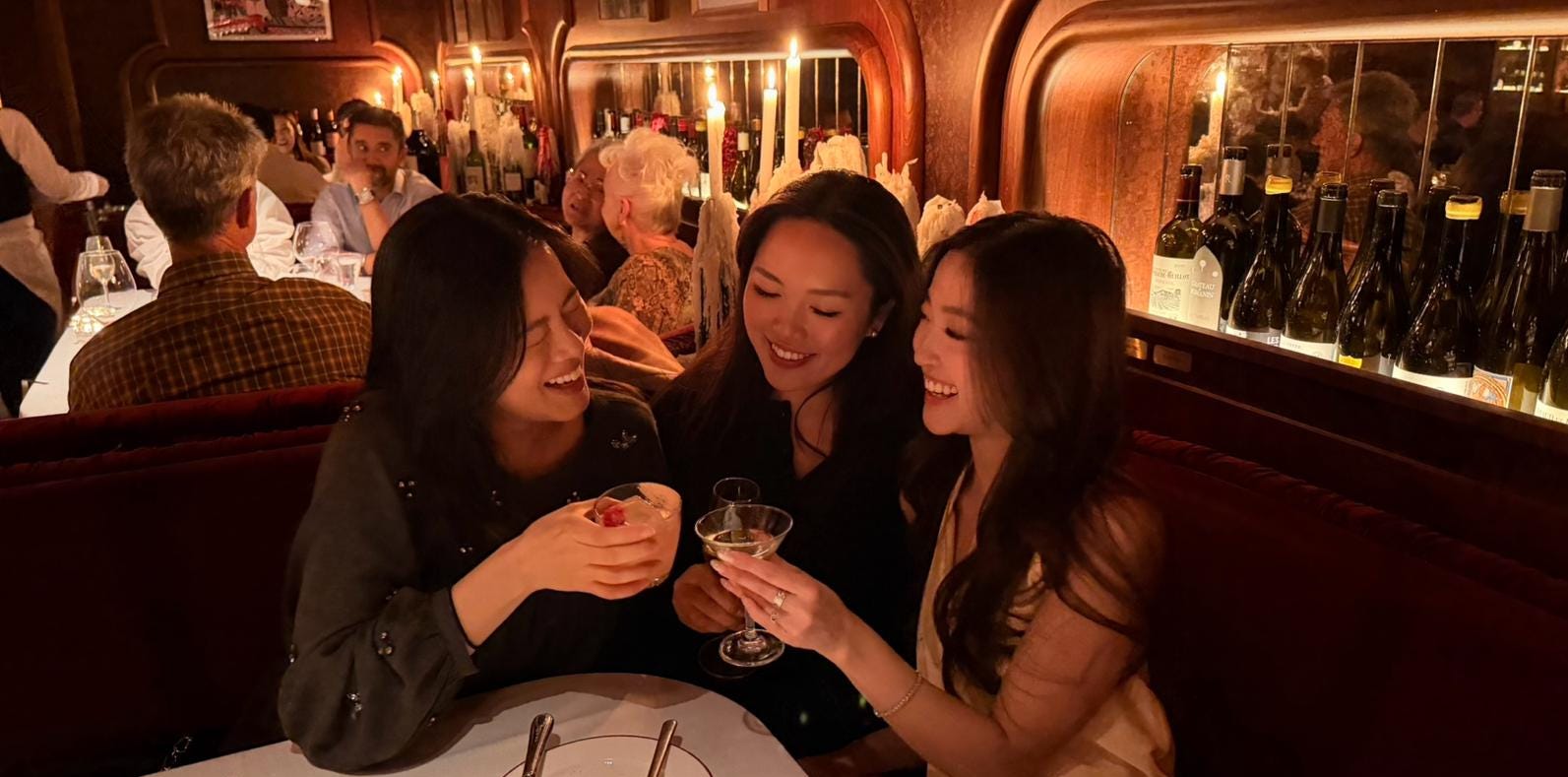
I used to dream of a bigger stage, a higher ceiling, a more electric world waiting somewhere beyond the one I was in, and I chased that horizon with the belief that expansion was the same as fulfillment, that scale would quiet the restlessness inside me. After years of striving, of stretching beyond my limits, and occasionally being handed the kind of humbling lessons that strip away illusion, I am beginning to see that part of who I am is not only defined by ambition or altitude, but also by something steadier, the capacity to be present, to listen well, and to be a genuinely good friend.
“There are some natures too noble to curb and too lofty to bend.” — Little Women
XOXO,
Your cute Asian girl